What is a Knitting Loom
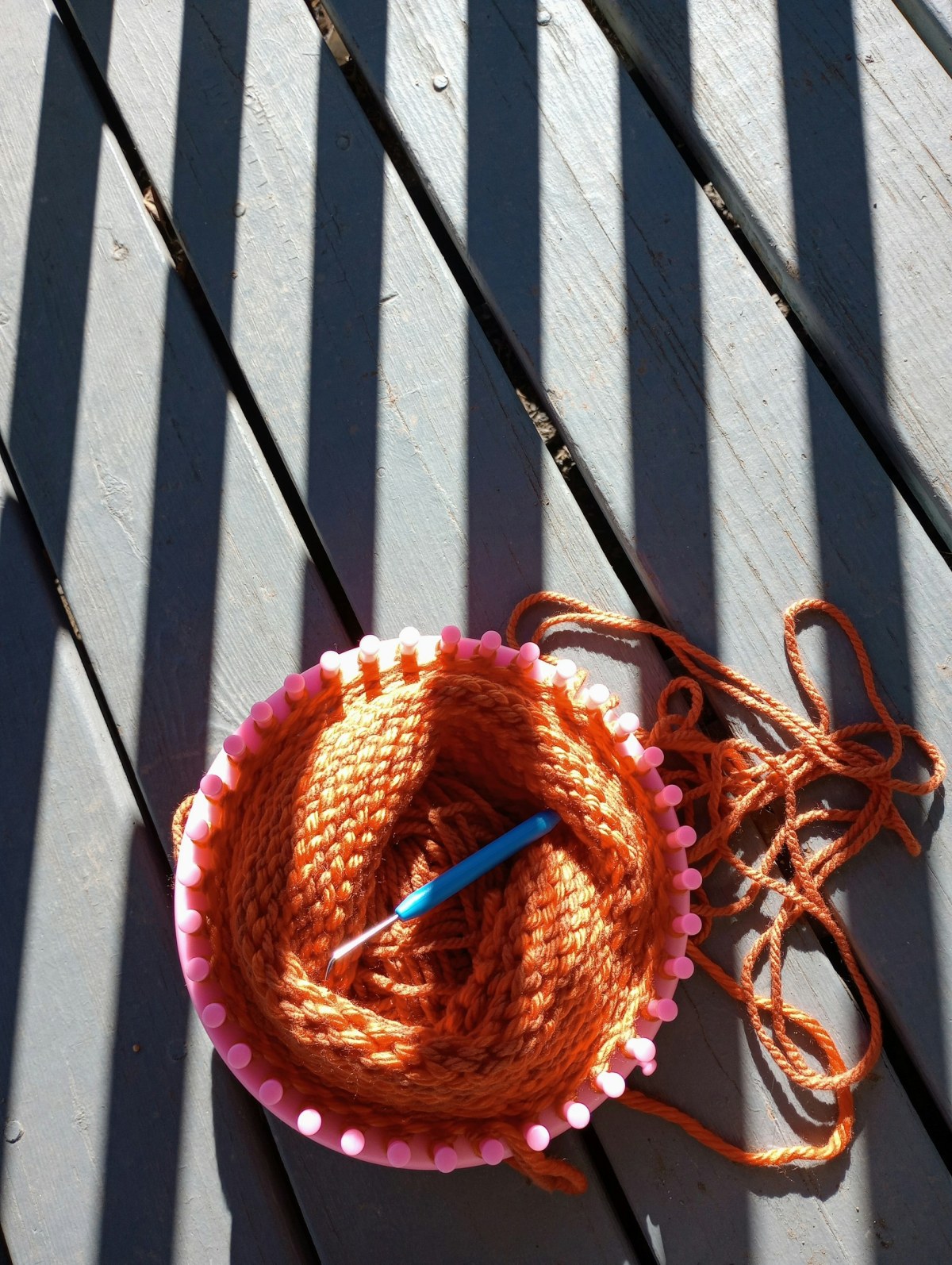
A knitting loom (also called a knitting ring) is a tool with pegs arranged in a circle, oval, or row, on which stitches are knitted using a special hook. Unlike traditional needle knitting, a knitting loom doesn't require coordinating two needles — stitches are wrapped around pegs and lifted with a hook.
Knitting looms are popular with beginners, children, and people with arthritis or limited hand mobility, because the movements are simpler and less strenuous. But they're not just for beginners — you can knit hats, socks, scarves, blankets, and even sweaters on a loom.
Types of Knitting Looms
Round loom — pegs arranged in a circle. The most common type. For hats, cowls, and knitting in the round. Diameter determines project size — small circle for child's hat, large for adult.
Long loom (rake loom) — pegs in a single row. For scarves, blankets, and flat knitting. Loom length = maximum project width.
Adjustable loom — pegs can be added and removed. Universal — one loom for various projects.
Afghan loom (S-loom) — S-shaped for wide projects (blankets). Saves space compared to long straight looms.
How to Knit on a Loom — Basic Process
E-wrap (Basic Wrap)
Step 1: Wrap yarn around each peg in an E-shape (front, left around, back). Go around the entire circle/row.
Step 2: Wrap a second row the same way — each peg now has 2 loops.
Step 3: Use the hook to lift the bottom loop over the top loop and over the peg. One loop remains on the peg. Repeat on every peg.
Step 4: Wrap another row and lift again. The fabric grows downward from the pegs.
Loom Size and Yarn
| Peg Spacing | Yarn Weight | Typical Use |
|---|---|---|
| Small gauge (10 mm) | Fingering, sport, DK | Socks, gloves |
| Regular gauge (13 mm) | Worsted, aran | Hats, scarves |
| Large gauge (19 mm) | Bulky, super bulky | Blankets, quick projects |
Advantages and Disadvantages of Looms
Advantages: Easy for beginners, gentle on hands and joints, even stitches without experience, good for children, portable.
Disadvantages: Limited project size (depends on loom), fewer patterns than needles, slower than experienced needle knitter, stitches have specific texture (loom knit stitch ≠ needle knit stitch).