Structure of a knitting pattern
Every knitting pattern has a standard structure. If you know it, you can navigate any pattern regardless of language or author.
1. Name and description
What you will knit and how the result will look. Sometimes includes difficulty level (beginner, intermediate, advanced).
2. Sizes
The pattern often lists multiple sizes — numbers in parentheses correspond to individual sizes. Example: CO 80 (88, 96, 104) sts = cast on 80 sts for smallest, 88 for next, etc. Underline or highlight your size before you begin.
3. Materials
Yarn (weight, recommended brand, yardage), needles (size, type), notions (stitch markers, needle, cable needle).
4. Gauge
Number of stitches and rows per 10 × 10 cm. The most important information in the pattern — if your gauge doesn't match, the garment won't be the right size.
5. Special techniques and abbreviations
List of abbreviations used in the pattern and explanation of special techniques that are not standard.
6. Instructions
The actual procedure — row by row, section by section (back, front, sleeves).
7. Finishing
Seaming, blocking, weaving in ends.
How to read numbers in parentheses
Most patterns cover multiple sizes. Numbers outside parentheses apply to the smallest size, numbers in parentheses to larger ones. Example: K15 (18, 21, 24) = knit 15 sts for XS, 18 for S, 21 for M, 24 for L. Before starting to knit, mark your size throughout the entire pattern — you'll save hours of confusion.
Written instructions vs. charts
Written instructions — line of text for each row. Comprehensible, but for complex patterns can be long and confusing.
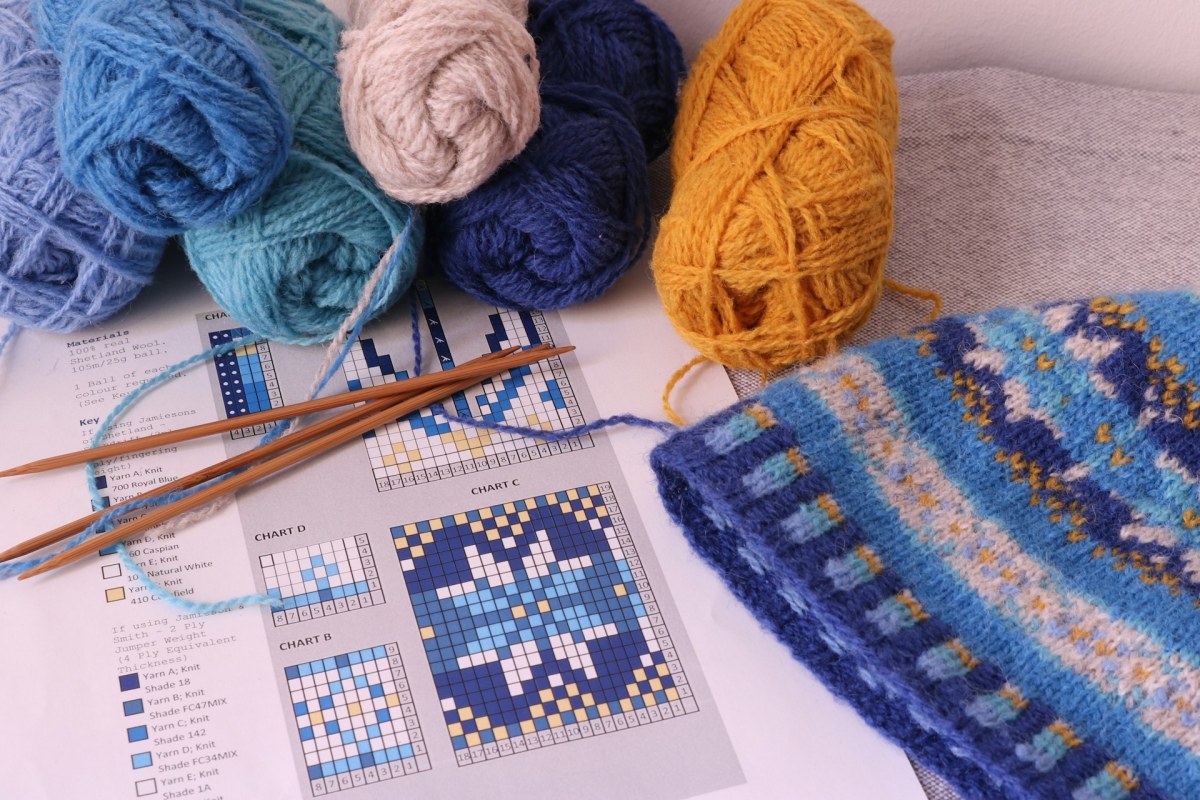
Charts — grid with symbols. More visual — you see the pattern at first glance. Read from bottom to top, odd rows from right to left, even rows from left to right. For circular knitting always from right to left.
Modern patterns often contain both — choose what works for you.
Common pitfalls
Confusing US/UK terminology — American "stockinette" = British "stocking stitch". Always find out which terminology the pattern uses.
Ignoring gauge — pattern says 20 sts per 10 cm and you have 22. For a shawl it doesn't matter, for a sweater it means a garment 2 sizes smaller.
Missing "at the same time" — if the pattern says "AT THE SAME TIME, decrease at neck edge" — you must do two things simultaneously. Don't overlook this.
Wrong size in parentheses — make sure you're following the correct position in parentheses throughout the entire pattern. Mark it for yourself.