Why Start with a Scarf
A scarf is the best first project for beginners. It's a straight rectangle — no decreasing, increasing, or shaping. You knit back and forth until you reach the desired length. Meanwhile, you'll practice even tension, stitch counting, and row transitions.
What You'll Need
Yarn: Worsted weight (medium), 200–250 g (approximately 2 skeins). Acrylic for beginners — it's forgiving, washable, and affordable.
Needles: Straight or circular, 5–6 mm (according to yarn weight).
Scissors and tapestry needle for weaving in ends.
Scarf 1: Garter Stitch (Easiest)
Skills needed: Cast on, knit stitch, bind off.
Instructions: Cast on 30 stitches. Knit every stitch in every row. Repeat until scarf measures 150–180 cm. Bind off. Weave in ends.
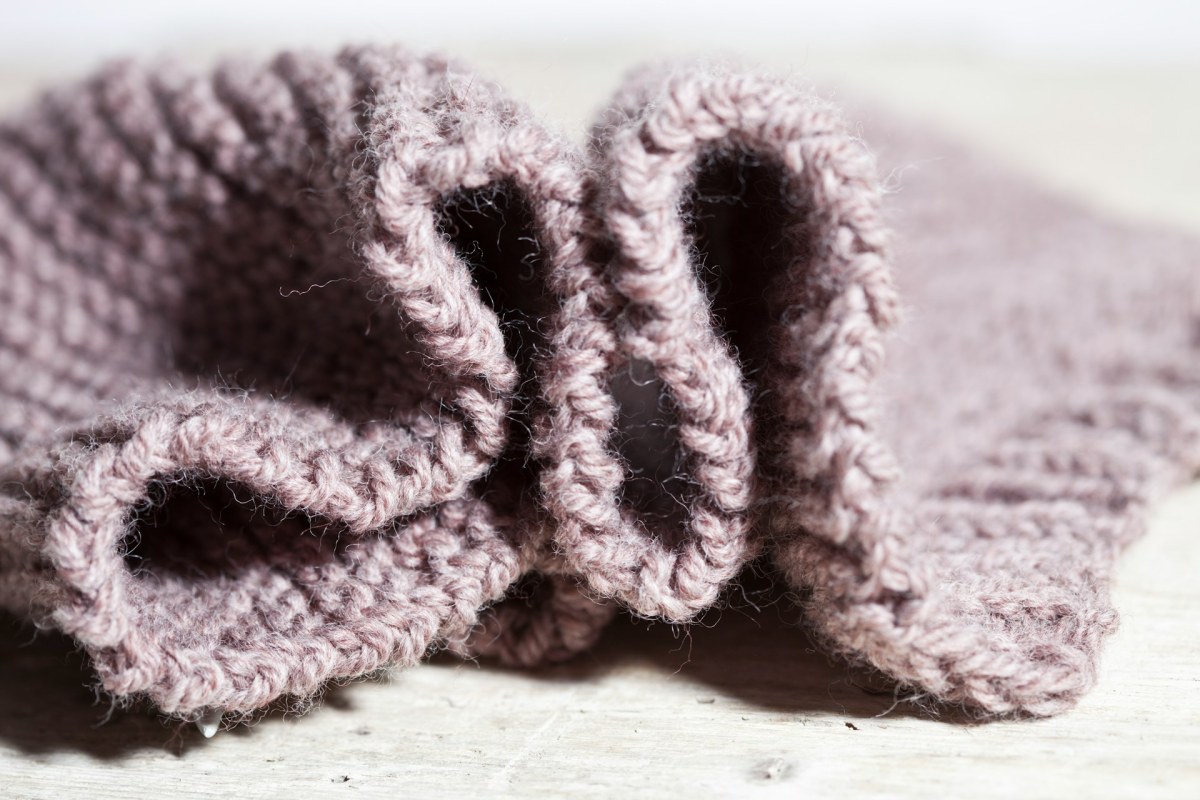
Done — an entire scarf from just one stitch. The texture is reversible with horizontal ridges and won't curl.
Scarf 2: Seed Stitch
Skills needed: Knit and purl stitches.
Instructions: Cast on 31 stitches (odd number). Every row: *knit 1, purl 1* — repeat to end, last stitch knit. Knit until you reach desired length.
Subtle textured surface, reversible, won't curl. Slightly more challenging — you need to alternate between two stitches.
Scarf 3: 2×2 Ribbing
Skills needed: Knit and purl stitches in columns.
Instructions: Cast on 32 stitches (divisible by 4). Every row: *knit 2, purl 2* — repeat. Knit until you reach desired length.
Distinct vertical ribs, very stretchy texture. The scarf will contract in width — finished width will be about 60–70% of cast-on width. Plan accordingly.
Recommended Dimensions
| Type | Width (cm) | Length (cm) | Stitch count (5 mm) |
|---|---|---|---|
| Narrow elegant | 15–18 | 150–170 | 24–28 |
| Classic | 20–25 | 160–180 | 30–38 |
| Wide / wrap | 30–40 | 180–200 | 46–60 |
Tips
Count your stitches every 5–10 rows — make sure you haven't added or lost any. If you want a fringed scarf, leave longer yarn tails at the ends and add fringe using 10–15 cm yarn strands pulled through the edges.