What is Double Knitting
Double knitting (abbreviated DK — careful not to confuse with DK weight yarn) is a technique where you knit two layers of fabric simultaneously on one set of needles. The result is a reversible, two-layer piece — on the right side you see a pattern in color A on a background of color B, on the wrong side exactly the opposite.
Double knitting is ideal for scarves, dishcloths, potholders, and trivets — anywhere you want a beautiful reversible piece with no visible wrong side.
Basic Principle
On your needle you have double the stitches — alternating stitches of color A and color B. In each "pair" you knit one stitch as a knit stitch (color A, for the right side) and one as a purl stitch (color B, for the wrong side). Both colors remain active throughout.
Process
Cast on: Cast on both colors alternately — 1 stitch A, 1 stitch B, repeat. Total stitch count = 2× pattern width.
Plain double knit (without pattern): *Yarn A to back, knit 1 with color A, yarn B to front, purl 1 with color B* — repeat. Both sides will be in stockinette stitch, but in opposite colors.
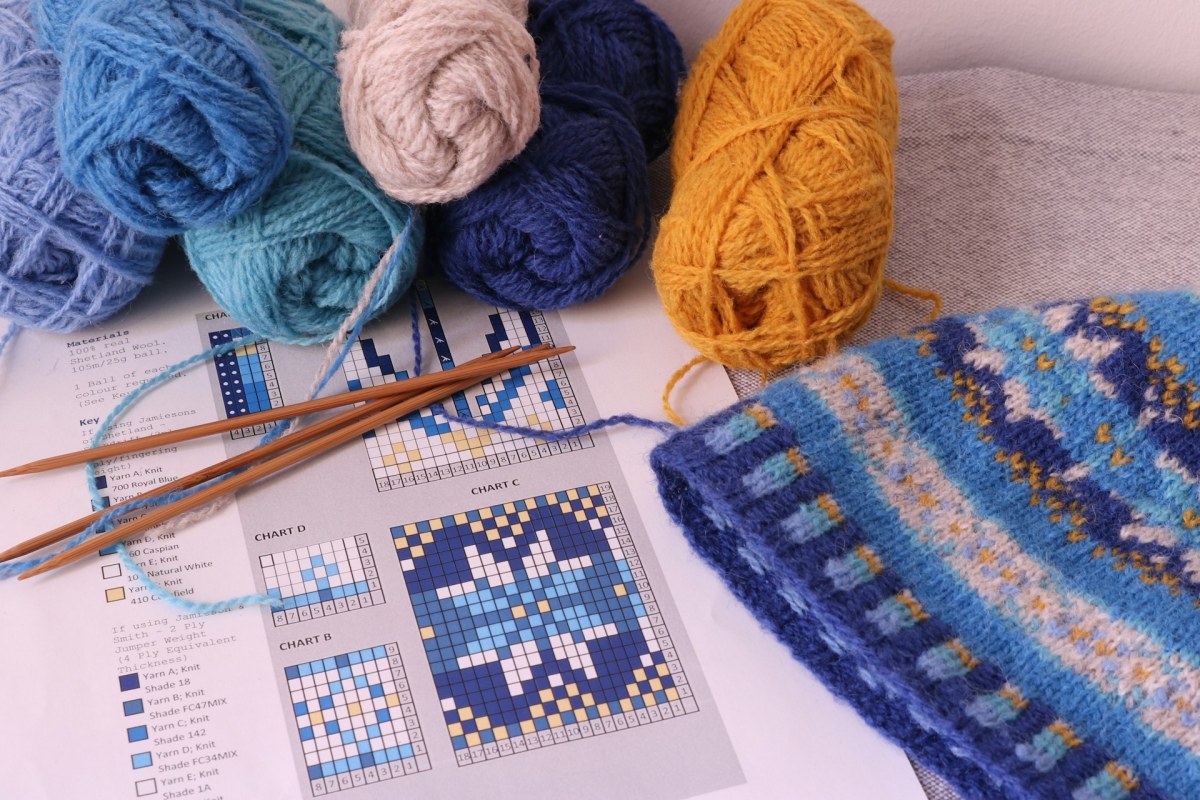
With pattern: Read a colorwork chart. Where the chart shows color A, knit on the right side with color A and purl on the wrong side with color B. Where it shows color B, do the opposite. Each square in the chart = 1 pair (2 stitches on the needle).
Properties of Double Knit Fabric
Double thickness — the piece is twice as thick as single-layer knitting. Very warm and insulating.
Reversible — both sides are "right sides" with stockinette stitch. No ugly wrong side.
Non-stretchy — unlike ribbing, double knitting is relatively flat and less elastic.
Projects
Scarf — reversible patterns are ideal. Checkerboards, geometric patterns, letters.
Potholder — double thickness insulates heat.
Knitted pictures — double knitting allows you to create detailed reversible images.
Tips
Start with a small project (20×20 stitch chart = 40 stitches on needle). Use high-contrast colors — you'll see the structure better. And keep count — with double knitting it's easy to lose track of where you are in the pattern.