What is moss stitch
Moss stitch is a textured pattern that creates a delicate, fine-grained surface structure resembling moss. It's popular for its simplicity and elegant appearance — it looks complex, but is built on the simple alternation of knit and purl stitches.
It exists in two variants — for hand knitting with needles and for crochet. Additionally, the terminology is somewhat confusing: in some sources, "moss stitch" and "seed stitch" are used interchangeably. This article will explain both.
Moss stitch vs. seed stitch — what's the difference
In American terminology, moss stitch and seed stitch are the same — you alternate knit and purl stitches in a row and in the following row you knit purl over knit and knit over purl. Each row is a mirror image of the previous one.
In British terminology there is a difference:
| Pattern | British definition | Repeat |
|---|---|---|
| Seed stitch | Alternating K/P in each row, each row the same | 1 row |
| Moss stitch | Alternating K/P, but pattern shifts every 2 rows | 2 or 4 rows |
For this article we'll use the American definition — moss stitch = seed stitch = alternating knit and purl stitches with a shift in each row.
Moss stitch knitting
Instructions (odd number of stitches)
Row 1: *K1, P1* — repeat to end, last stitch knit.
Row 2: Same as row 1 — *K1, P1* to end, last stitch knit.
Repeat rows 1 and 2. The key is that you knit purl over knit stitches and knit over purl stitches. Each stitch "protrudes" from the row and creates that characteristic grainy texture.
Why it doesn't curl
Unlike stockinette stitch, moss stitch doesn't curl at the edges. This is because knit and purl stitches are evenly distributed across the entire surface — the tension is balanced. This makes moss stitch great for scarves, blankets, and edges without needing to add border patterns.
Moss stitch crochet
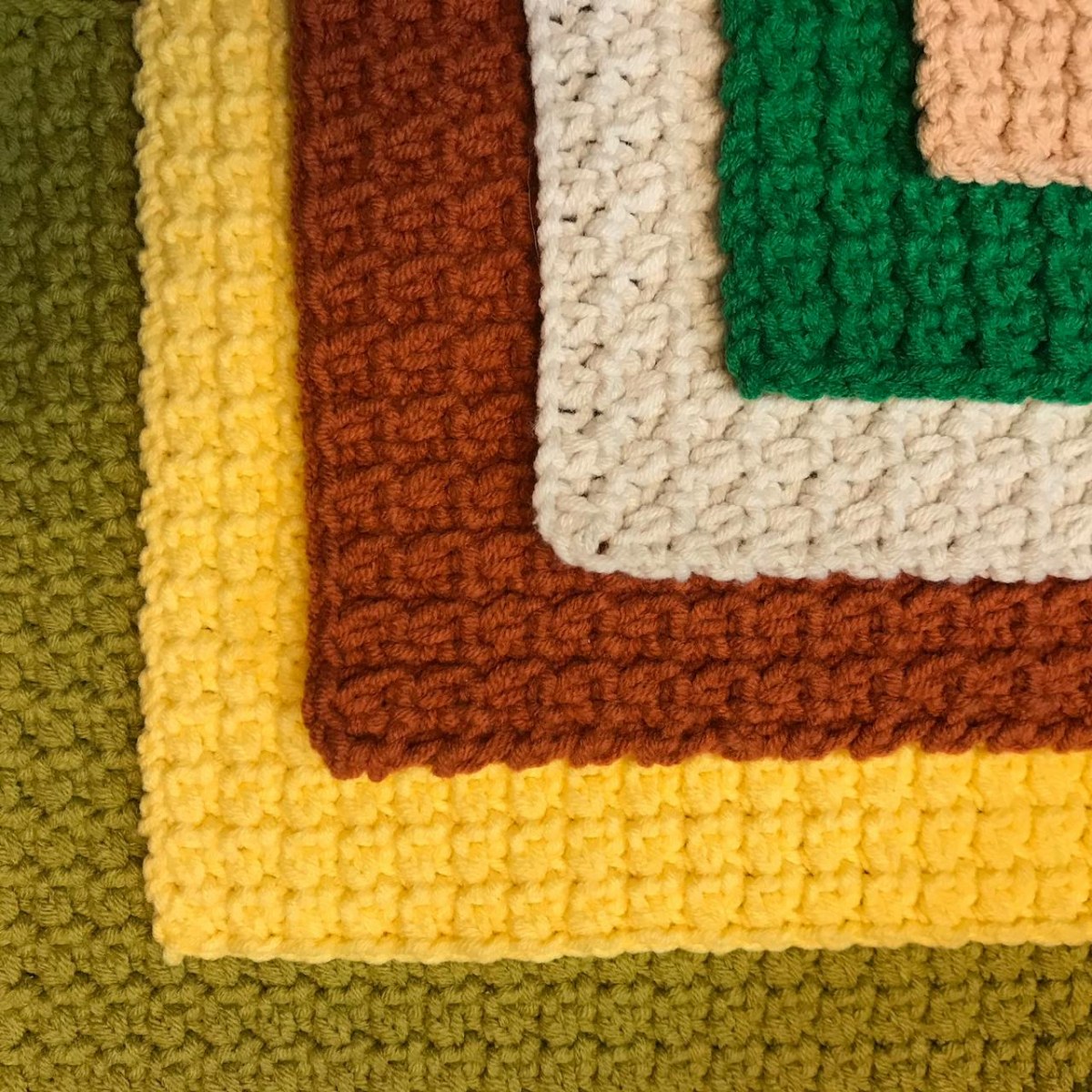
The crocheted version of moss stitch uses alternating single crochet and chain stitches:
Row 1: 1 single crochet, 1 chain stitch, skip 1 stitch — repeat.
Row 2: Single crochet into chain space of previous row, 1 chain stitch — repeat.
The result is a delicate, slightly lacy texture with regular gaps. It's more airy than the knitted version, but still has a distinct "mossy" structure.
Suitable projects
Scarves and cowls — moss stitch is reversible (looks the same on both sides), which is ideal for scarves. It doesn't curl, so it doesn't need a border.
Baby blankets — the soft, gentle texture is pleasant to touch. Straightforward work without complications.
Pillows — the texture gives pillows an interesting surface without complex patterns.
Borders and panels — moss stitch is often used as an edge pattern on sweaters or blankets because it doesn't curl and creates a clean transition.
Tips
Count your stitches — with moss stitch it's easy to lose track of whether you should knit or purl. Simple trick: look at the stitch below your needle — if it looks like a "V" (knit), you purl. If it looks like a "wave" (purl), you knit. You always work the opposite of what you see.